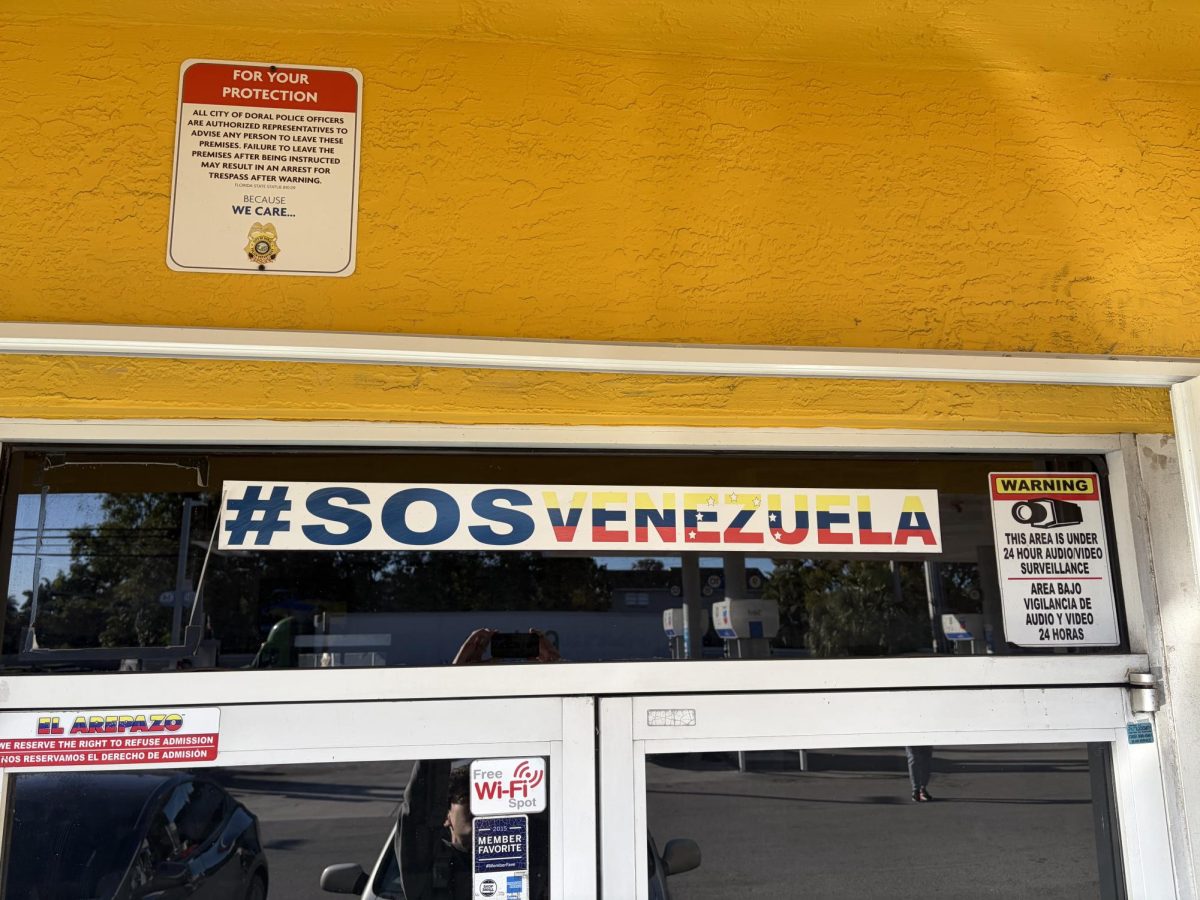
On January 3rd, 2026, the United States federal government captured Venezuelan leader Nicolas Maduro in an effort to put a halt to his authoritarian regime. This has sparked profuse controversy on a global, national, and local scale. More particularly, the event has sparked controversy in Miami due to the large Venezuelan community.
As the current geopolitical landscape continues to rapidly evolve, so do the opinions of young people. In the weeks after Maduro’s capture, several viewpoints emerged among Ransom Everglades students regarding the current affairs between Venezuela and the United States.
The Catalyst polled 75 students from diverse backgrounds and age groups on their feelings towards the act of capturing Maduro and whether they believed it would bring prosperity to the affairs between the US and Venezuela or cause instability. A 56% majority of students said that they felt the capturing of Maduro would bring prosperity to the nation, while 44% expressed a sentiment of unease towards the action.
Some students expressed the belief that the U.S. acted as a liberating force to the residents of Venezuela. “I am definitely happy for the people of Venezuela for being freed in a sense,” said Eitan Sawicki ’28. Amalia Macias ’28 echoed Sawicki’s view. “I feel very relieved and happy for the people of Venezuela… and I am happy the government took the initiative to capture him,” she said.
Other students, however, said they believe it will cause further turmoil on a global scale. Lila Yale ’28 said she did not appreciate how it “came out of nowhere,” adding, “I think there may be a temporary satisfaction for the Venezuelans, yet I do not think that will last.”
Assistant Speech and Debate Coach Justinmar Perez expressed a similar view. “I think people are letting their feelings get too in the way of the geopolitical consequences of the action,” he said.
Critics of the action said that their unease stems from the fear that capturing the leader of another nation is “unconstitutional,” said Joey Louis ’28, who added that the lack of congressional approval for the action established a dangerous precedent that other Presidents may be able to follow.
A gray area also existed in student responses, as represented by Nicholas Torres ’27. “I think that it leads towards a precedent being set on whether countries can invade other countries or not… I think that there are different perspectives about whether or not our president had the authority to do that,” he said. Several other students were hesitant to share a definitive view on the matter, reflecting a broader sense of uncertainty over the legality, morality, and global implications of the U.S.’s operation.
The perspectives of Venezuelans themselves offered another dimension to the discussion. According to the Substack Latin America Risk Report, surveys prior to Maduro’s capture showed that 80% of the people of Venezuela wanted him gone. Venezuelan students at RE felt similarly—with qualifications. “As a Venezuelan, I am very glad that Maduro is gone, but I think that the United States should give the country over to the legitimately elected president, since it is kind of obvious that the president [Donald Trump] is just there for the oil. Regardless, me and other Venezuelans are just happy that Maduro is gone… and we all hope that the country will go back to how it was before Maduro.” said Cecilia Cisneros ’28.
“My family and I are very happy, obviously, that Maduro was taken out of his presidency,” added Sofia Shore ’28, another RE student of Venezuelan heritage. “As a corrupt leader he led the decline of Venezuela; it was a very beautiful country, and he made it very hard for it to flourish. Though yes, it caused instability, I still think it was a positive thing, and I hope that good things are ahead for the future of Venezuelans.”