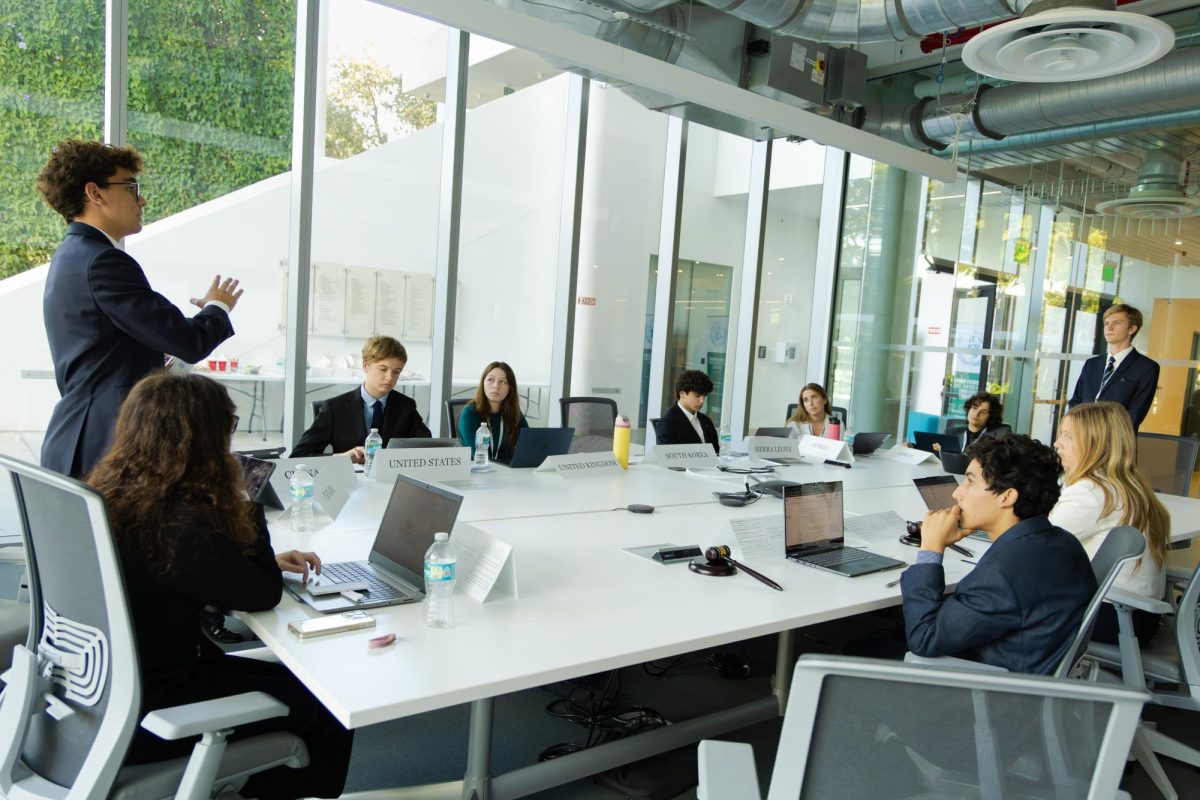
Ransom Everglades made history this month by hosting its first-ever Model United Nations conference, REMUN, bringing together student delegates from schools across South Florida to engage in lively debate and collaborative problem-solving. The conference featured four chambers: the General Assembly, the Economic and Social Council, the Human Rights Council, and the Security Council. Each provided a platform for students to confront pressing global issues and simulate the workings of the United Nations.
From the moment the conference began, the energy in the chambers was palpable. Delegates arrived armed with extensive research and an eagerness to discuss topics ranging from climate change and global economic inequality to human rights abuses and international security threats.
“My vision for this conference was for Ransom to engage with more of the South Florida community,” explained Ana Gonzalez ’26, President of Model UN. “We go to national conferences in The Hague and in New York City, but we don’t go to many local conferences. I think that it is very important as one of our core values is community. I think it’s very important to get our delegates talking to people from other schools and getting to know people from other schools.”
The event followed traditional parliamentary procedures. Committees moved through both formal debates—where delegates deliver speeches and follow strict speaking rules—and moderated or unmoderated caucuses, where discussion was more flexible for negotiation or drafting resolutions. Delegates used motions to shape the flow of debate, such as requesting a caucus, introducing draft resolutions, or moving to a vote, and each committee was overseen by a chair who maintains order and neutrality.
For the REMUN students who chaired sessions, preparing for the conference involved a rigorous training process behind the scenes. “We went all the way down to the basics, like parliamentary procedure,” said Head Chair Luca Akin ’27. “Just making sure that we ran through the debate in a parliamentary process, corrected delegates when they used personal pronouns, little things like that. European-style debate, which is what we operated at REMUN, is very different from American style.”
Meanwhile, the Approval Panel, composed of Armin Stamate ’26 (Vice President of Model UN), Oscar Vazquez ’26, and Charlie Reizenstein ’26, played a key role in shaping the debates by selecting which resolutions would be considered. Stamante explained their approach: “What we aim to pass usually in our approval panel is something that would be debatable. In a debate, we don’t look for the best resolution that has every single flaw taken care of. We want something that’s a bit risky, and something that takes risks that might not be agreeable to every single country.” Together, the chairs and Approval Panel worked to ensure that each chamber maintained engaging and educational discussions throughout the conference.
Faculty advisors praised the dedication and enthusiasm of the student organizers. “They were brilliant in their execution, the ordering of the supplies, the stationery, everything was pulled off very well because of their foresight, their ability to meticulously outline all the different criteria,” said History and Social Sciences teacher Mr. Stephen Allen, the sponsor of Model UN. “Their coordination with the other schools was brilliant, and their registration of students and creation of the committees were all done in a way that greatly benefited the conference. They truly exemplified student leadership and initiative in pulling that off. I am very proud of them.”
Delegates from schools across the region earned top honors for their leadership and diplomatic skill at the conference. The General Assembly imagined a sudden blackout across New York City, triggered by a suspected cyberattack, which heightened the urgency of their discussions and ultimately led to the passage of the Netherlands’ resolution on global AI-era surveillance standards. Lucia Lopresti ’28 of Gulliver earned Best Delegate for her strategic coalition-building and ability to stay calm under severe pressure.
In the Economic and Social Council, delegates focused on developing sustainable and equitable climate-financing systems for vulnerable economies, discussing transparency, fairness, and the balance between national responsibility and international support, with resolutions from the United States and Panama both passing. Luc Dambournet ’28 of Ransom Everglades earned Best Delegate for his constant engagement and ensuring that his country’s needs were consistently met.
The Human Rights Council examined protections for incarcerated individuals, including access to healthcare, fair trials, and safeguards against abuse, while working to strengthen accountability and establish international monitoring standards. Alexandra Papp ’27 of MAST Academy earned Best Delegate for her strong advocacy and command of human-rights law.
Lastly, the Security Council addressed rising tensions in the South China Sea, emphasizing freedom of navigation, adherence to international law, and strategies to prevent armed conflict in the region. Rodrigo De Lamo ’27 of Immaculata La Salle High School earned Best Delegate for navigating tense negotiations and guiding the council toward consensus.
Students and faculty alike celebrated the event as a meaningful opportunity for experiential learning, where theoretical knowledge meets practical application. Participants said that the REMUN conference not only tested students’ public speaking and research skills but also emphasized the importance of collaboration. Delegates learned that diplomacy is not only about persuasion, but also about compromise and understanding perspectives different from one’s own. “REMUN was such a great experience for me,” said Tess Pearson ’27. “I learned a lot about how to speak up and share my ideas clearly, and how to work with other people to get things done. It was really cool to see everyone figure out solutions together.”