Whether it be through Netflix, Prime Video, Hulu, or Disney Plus, in today’s world we are able to watch almost any show or movie anytime and anywhere. New series and films are constantly being released, each competing for our attention. However, despite this endless stream of content, many of these newer shows struggle to reach the same level of popularity as those from the ’90s and 2000s.
More than two decades after their release, high school students are still obsessed with, and loyal to, these shows. To us, shows like “One Tree Hill,” “Gossip Girl,” “Gilmore Girls,” and “Boy Meets World” represent peak entertainment, which raises a question: why? What is it about these shows that has captured our imaginations?
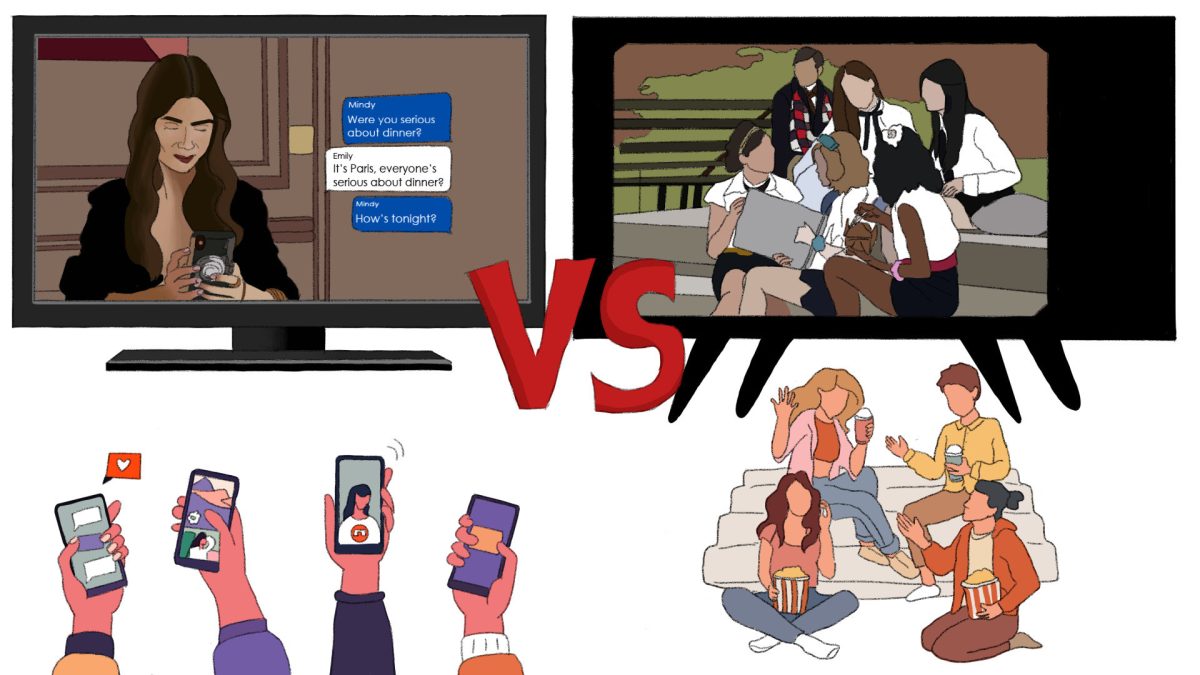
One answer: not a phone in sight. In the 2000s, social media was only beginning to emerge and had not yet become a dominant force in everyday life. Today, however, social media is nearly inescapable, and that contrast is exactly what makes these older shows so appealing.
“Because there is less social media, the actors in the show do more and are able to go out more. This adds more action to the show in and of itself,” explained Annie Minick ’27.
Minick’s comment highlights how the absence of constant phone use allows for richer plots and more dynamic interactions. Without phones dominating every scene, characters seem able to experience life more fully and step outside their immediate circles. If characters were constantly staring at their phones, there would be less room for meaningful social interaction, development, or conflict.
“Even when I watch a show made now, this is going to sound cliché, but everyone has a phone. When a plot revolves around an iPhone or something like that, it makes me mad,” said Katy Elgarresta ’27.
Take recent shows like “Emily in Paris,” “Euphoria,” or “Never Have I Ever,” where most of the plot revolves around texting or social media. Characters receive their information through social media platforms and obsessively check their phones. For many students, the presence of phones and social media in modern television is frustrating rather than relatable. When watching TV, they want an escape from their daily lives, and especially from the smaller screens that already consume so much of their time.
At the same time, we do have to thank social media for popularizing the ’90s/2000s aesthetic. Social media platforms keep these TV shows alive. The soft lighting, grainy camera quality, early-2000s fashion, and nostalgic music create a recognizable tone that resonates with the students who seek comfort and authenticity online. These shows are no longer just watched; they are edited, curated, and reinterpreted as mood boards, character edits, and lifestyle inspiration.
This leads to another key reason for the enduring popularity of 2000s television: nostalgia. Although the 2000s are over, that does not mean they have truly left us. Even as we grow older, the things we loved during childhood continue to provide a sense of comfort and reassurance.
As Ellie Feldman ’27 explained, “It’s like looking back and having kind of a fuzzy camera, a different type of audio, and listening to the different music. That’s the music that I kind of grew up on that’s playing in those TV shows.”
While we may believe we’ve outgrown our childhood, these shows remind us of it in subtle but powerful ways. Without even realizing it, we are drawn to the familiarity and warmth they provide, evoking memories of a simpler and calmer time.
Blythe Silvetz ’27 captured this feeling perfectly: “The shows that we watch now might be more plot-entertaining, and we might keep wanting to watch the next episode. But the shows from the 2000s have a sense of calm and roundedness, and I think that’s something beautiful.”
While contemporary shows often rely on intense plot twists and high-stakes drama, many students are simply looking for comfort: something that allows them to relax and watch characters live relatively normal lives. This “calmness” that Silvetz refers to is the slow pacing of these television shows, where episodes are often focused on everyday moments and the interactions between characters rather than the non-stop plot twists.
The continued love for ’90s/2000s TV shows reveals something deeper than just entertainment preferences. It shows that, despite how fast-paced and technology-driven our lives have become, we still crave stability and familiarity. No matter how much time passes, our childhoods remain an important part of who we are.
Dana Chopp ’26 reflected this sentiment. “These shows give me comfort and stability when I need it most. They’re not too crazy, but they still have plots that I can enjoy.”
In a world filled with constant stimulation and endless scrolling, these TV shows offer students a rare sense of calm, proving that sometimes, looking back is exactly what helps us move forward.