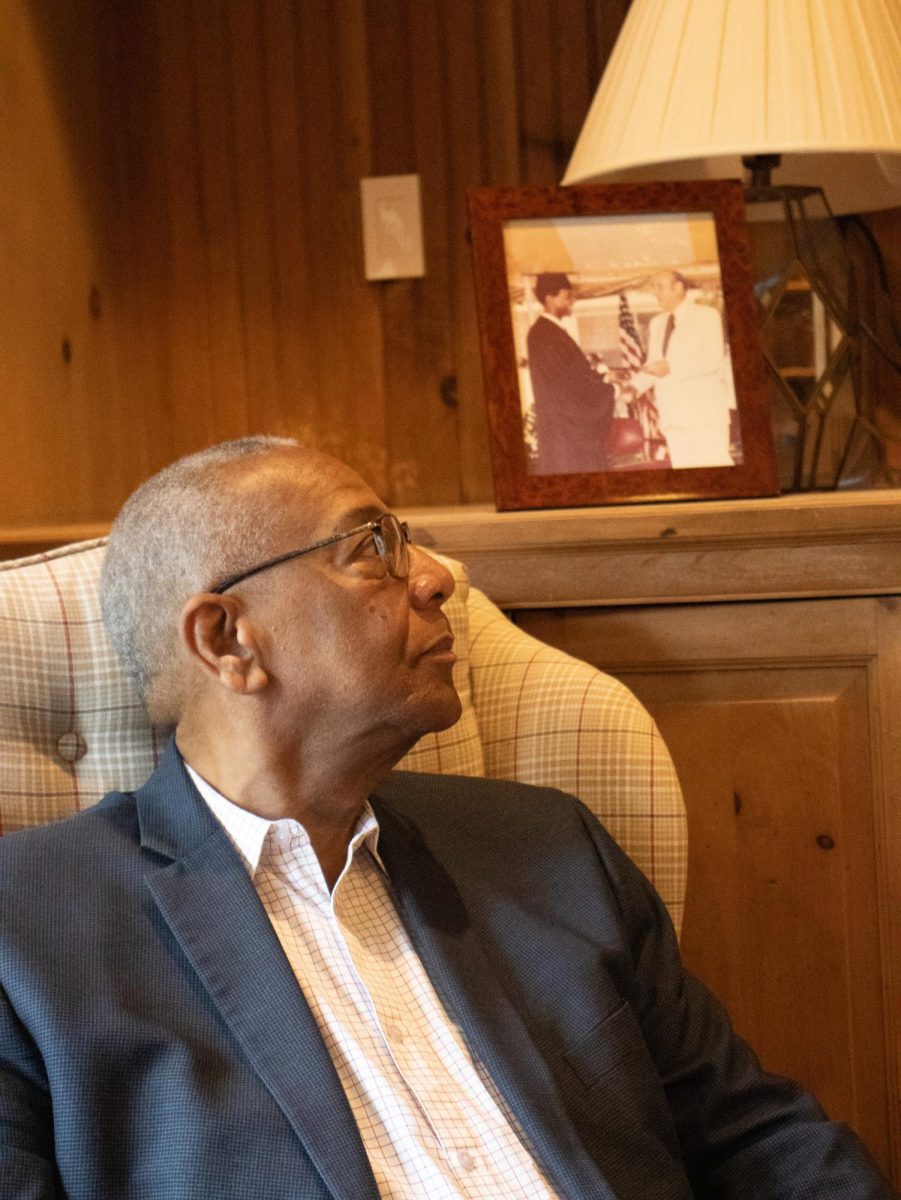
Judge Wendell Graham’s office at Ransom Everglades feels less like a workplace and more like a living archive of memory. Wooden cabinets line the walls, filled with books that span generations—”Black Boy” by Richard Wright, “Harry Potter” by J.K. Rowling, and the wartime survival tale “We Die Alone.” Framed photographs from Ransom’s history hang with care, capturing moments both personal and institutional. At the center of the room sits a sturdy desk, scattered with papers and anchored by a large computer screen, evidence of work still in motion. A fireplace lined with wooden planks rests beneath a striking painting: Harry Anderson ’38, sits calmly in a chair, reading a magazine titled Yachting. Bottles of water are tucked here and there, as if expecting visitors to stay awhile.
And when Judge Graham looks out that window, he doesn’t just see the future of the school—he sees the boy he once was, the first Black student to walk the halls of the Ransom School for Boys in 1969. Back then, he embodied the only diversity at Ransom. Now, he serves as Ransom’s Director of Diversity, Equity, and Inclusion.
* * *
Graham grew up in Liberty City, but his family had deep roots in Miami as one of the earliest African American families in the city. His grandmother, Mae Foster, was born in the Bahamas in 1896 and came to Miami in 1916. He lived with his mother, his grandmother, his brother Michael, who was eight years older, and his sister Gretchen, who was ten years younger.
Growing up without a father, Graham saw himself as the protector. He became a father figure to his two siblings. “You learn to exist on your own because it feels like having three kids to care for. It was like being my own brother and my own father. It makes sense that I was a father to my siblings,” he said.
Graham emphasized that his neighborhood wasn’t what outsiders assumed. “From the outside it would look rough, but that neighborhood wasn’t what people thought it was. Yes, that area was where some of the major Miami riots took place. But for a long time —really, up through the 1960s—Miami was extremely segregated.”
He recalled a conversation with a police officer who told him he’d worked the area for years but had never actually been inside the neighborhood between NW 22nd and 17th Avenues, and between 54th and 62nd Streets. “That was the heart of Liberty City,” Graham said. “And I told him, that’s where the good folks were. Sure, there was government housing, like the Pork & Beans projects, but in other parts, you had professionals. My neighbor was a physician. Across the street, we had a school principal.”
Graham explained that in Liberty City, people from different races didn’t often talk about each other’s cultures. He believed that much of the misunderstanding came from a lack of exposure, not active hostility. “From my personal experience, the more you learn about other cultures, the more you realize how much we have in common. Yet, we still live in segregated communities. For instance, if you go out to Coral Gables, you’ll find that despite the overall percentage of Black Americans in Miami, you’re not likely to see them living in Coral Gables, no matter their success,” he said.
***
Graham first attended Charles Drew School, then transferred to Academy of Assumption, a Catholic elementary school. He returned to Charles Drew for middle school. Trained as a classical violinist, he was offered a chance to attend a music school in North Carolina at just 13 years old. But his mother did not want him to move far away. Ruth Greenfield, a musician, introduced him to the Headmaster at Ransom, which had no Black students.
At Ransom, conversations about desegregation began. “A senior, Tim Greenfield, raised the issue that Ransom didn’t have any Black students. There were Latino and Hispanic students, but not many,” Judge Graham explained.
Judge Graham understood the significance of his enrollment, noting that a local newspaper wrote about him as the school’s first Black student. But he believed Ransom should be proud of how it handled the transition. “Not every place was so smooth, especially in 1969. But at Ransom, things were calm.”
“Everyone treated me with respect. The head of school, Robert Walker, checked in with me weekly. Spanish teacher and soccer coach Jim Beverly ’62 always made time to ask how I was doing— ‘How are you? What’s going on? Are you going to this activity? Do you have a date to bring to the dance?’ Some days, you didn’t realize you needed to talk. But then someone brings it up, and you realize, ‘Actually, I have three assignments to catch up on.’”
Judge Graham was active in school athletics. He played on the basketball and football teams and, in eighth grade, was placed on the varsity water polo team. He described the football team as especially close-knit, recalling a standout season with eight wins and three losses—his most memorable football year in 1973. As a senior and team captain, the experience of growing, working, and learning together made it even more meaningful. “At Alumni Weekend, I still see my old teammates—we always catch up and reminisce,” he said.
At the time, the Everglades School for Girls had four Black students, but overall, Graham didn’t see much diversity at the school, and especially with communities Ransom interacted with.
Ransom itself had no Black faculty. The only other Black individuals on campus were the groundskeeper and a few support staff.
“It was disheartening to not see many others who looked like me,” Judge Graham said. “But that’s just how it was. We came from different worlds. We didn’t live in the same neighborhoods, attend the same churches, or participate in the same cultural or social activities. It wasn’t intentional exclusion—it was just a lack of shared experience.”
He acknowledged the difficulty of transitions when new groups enter longstanding institutions. “Whether students, staff, or faculty, if you only have a few people from a particular racial or ethnic group, it’s hard to feel like you truly belong. You feel like a blip on the radar. It takes real listening and intentionality to figure out what people need to feel comfortable—and to give them what they need to thrive.”
***
After graduating, Judge Graham attended Columbia University, majoring in English with aspirations of becoming a lawyer. He later earned his law degree from the University of Miami School of Law. Over his legal career, he worked with Neil G. Taylor, President of the National Association of Criminal Defense Lawyers, and Janet Reno, his role model and former U.S. Attorney General.
Janet Reno often asked him, “What should a prosecutor be used for?” Her answer was always: “Responsibility.” She explained that a prosecutor’s primary role is to ensure justice—not to win convictions, but to make sure innocent people are never charged.
Judge Graham eventually opened his own legal practice, which he ran for six years before being appointed as a county judge in the Miami-Dade Court of Florida in 1994. After serving on the bench for 24 years, he retired in 2018.
On Juneteenth in 2020, Black alumni wrote a letter outlining their challenging experiences as students at Ransom Everglades, which prompted the creation of the school’s Anti-Racism Task Force. At the time, Judge Graham was enjoying retirement, but during the COVID-19 pandemic, Head of School Mrs. Penny Townsend invited him to join the newly formed initiative. The task force was established to foster an anti-racist environment at Ransom and to implement diversity, equity, and inclusion training for faculty and staff. One of its primary goals was to increase Black student enrollment by 10 students, with a particular focus on admissions in the 6th and 9th grades.
In 2021, following the task force’s work, Mrs. Townsend asked Graham to serve as Ransom Everglades’ Director of Inclusion and Community Engagement.
“I took the position because I understand the need for diversity and inclusion in schools, even if I didn’t have formal training in it,” he said.
Since then, Judge Graham’s efforts have included integrating multicultural perspectives into classrooms, celebrating cultural heritage within the school community, and ensuring that all members feel valued. Looking ahead, he aims to help Ransom Everglades remain a world-class institution by continuing to recruit top talent from across the globe and maintain a culture where everyone can thrive.
“It can be challenging for new staff or faculty from underrepresented backgrounds. The transition isn’t always easy. When teachers are juggling five classes a day, they often don’t have time to focus deeply on inclusion. And for students, it’s critical to ask: What do they need to feel seen, supported, and able to thrive?”
Decades after Judge Graham arrived at Ransom as a student, and after a long legal career, he finds himself on a changed campus. His wood-paneled office is in La Brisa, a building that was a private residence when he was a student. A modern glass STEM building sits in the front of campus. There is now a Black Student Association and an annual Black Alumni Reunion.
Still, pursuing diversity among the student body is an ongoing challenge. In the 2024–25 school year, 90% of families at Ransom participated in a cultural survey, revealing that of approximately 1,200 students, 14% identify as Asian, 9% as Black, 5% as Middle Eastern, 1% as Native American, less than 1% as Hawaiian or Pacific Islander, 60% as White, and about 40% as Hispanic or Latino. Black students make up less than 10 percent of the graduating senior class.
“My goal at Ransom is to bring together diverse perspectives,” Judge Graham said. “When you see more racial and even religious diversity in a school, it opens doors—for conversation, understanding, and connection. We gain different perspectives in our classrooms, and learning to listen to and appreciate those perspectives helps you grow into a more thoughtful individual.”