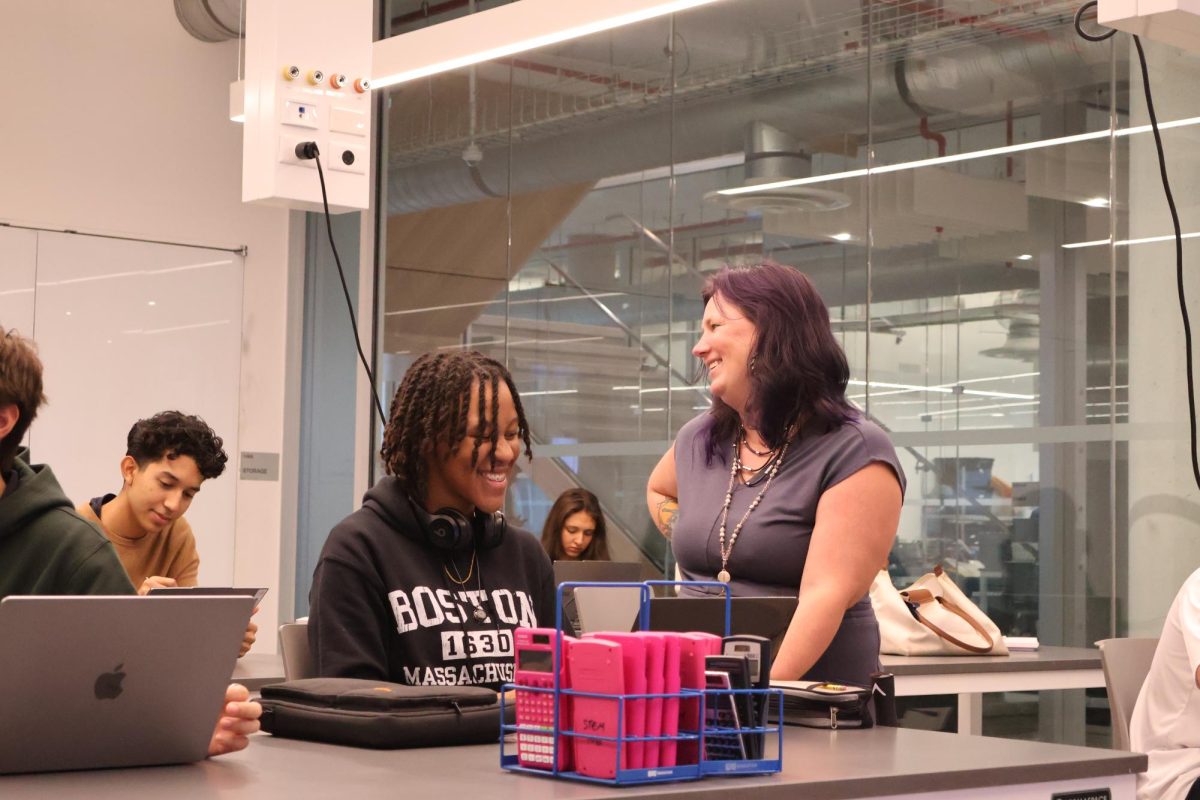
With two train rides, eight and a half miles of biking, and hours of trekking each day from Hollywood, Florida to our school on the bay, physics teacher Dr. Emily Grace quite literally goes the extra mile.
But behind the flowing purple hair, funky style, and knee-high suede boots was a nine-year-old girl filled with anxiety from being told by her own two parents that she wasn’t smart enough to take science and math classes.
If only she could tell her younger self that she would publish extensive research about dark matter, become a physics professor at a college where she would go on to build two majors, and teach physics at our own Ransom Everglades.
Born in rural Kentucky and raised by two missionaries, Dr. Grace moved to Madrid when she was one year old, where she spent most of her childhood. Dr. Grace lived in Kentucky until she was five, returned to the United States for two years, and moved back to Madrid once again when she was eight.
“I’m a third culture kid; I grew up in a culture that isn’t mine. I’m a missionary kid, which comes with its own separate kind of circumstances,” she said.
When Dr. Grace was in eighth grade, her family made the move back to Kentucky once again—but this time, it was a much more dramatic culture shock. She found it difficult to “socially engage with American kids.”
“I never really fit in socially in Kentucky. I’m not someone who changes for other people. And so, in a place like Kentucky where you’re expected to conform to find a group, that was never going to work. I was never going to conform. I’d rather just be alienated,” she said.
The summer going into Dr. Grace’s junior year, her family moved to New Jersey because her father got a pastoral position at a church. She went to a school with just over two thousand students, which was a much better fit for her.
“My multicultural background made less of a difference because other people there had lived in different countries, had different experiences,” she said. “When you’re in that big of a crowd, if you’re a little bit weird, it doesn’t matter because there’s other people who are a little bit weird, too.”
Dr. Grace was naturally a science whiz, and she became known (and unfavored) by her fellow students for blowing every curve.
“I was like, you know what? I am not going to take another science class where I’m bored again. I am tired of being disliked. I am tired of all of this,” she said.
Things changed when her chemistry teacher, Mr. Spears, pulled her aside. “He said, ‘You’re going into advanced physics.’ He told me I didn’t have a choice in the matter. And doing that changed my life,” Dr. Grace recalled.
Throughout her life, her parents had been less than supportive of the idea that she could do math and science. “I have struggled with math and science anxiety for a huge chunk of my life,” she said. “When I was in elementary school, I talked about wanting to be a scientist and my dad told me that I wasn’t smart enough to do math. My mom told me I wasn’t the right type of personality to do science. Those things really stick with you when you hear them when you’re nine.”
But she found herself through physics. She fell in love with the concept of modeling the universe through equations, and the phenomena behind dark matter. She dreamed of majoring in physics in college—until her parents, once again, had different ideas.
“The college decision was contentious in my household. Basically, I was told either I could go to a Christian college, or I could live at home and go to Rutgers,” she said.
Grace solemnly thought this was the end of her short-lived physics career. She neither wanted to go to a Christian college, nor live at home, so she went to Bethel College, a small religious institution, because it was her farthest option.
Bethel did not have a physics program, and her original declared major was international business, which couldn’t have been further from her passion.
She was bored to tears in her classes, breezing through them with minimal effort. However, as hard as she tried, she couldn’t stop thinking about physics, longing for a time when her true passion would be accepted.
On top of these feelings of discontent, Grace’s parents were going through a difficult divorce, which only escalated her feelings of alienation. She felt as though there was no room in her family dynamic for her. “College then became about surviving,” she said.
Grace graduated college in three and a half years and married her first husband shortly after, which she regretted deeply.
“I think, you know, for me, I was trying to escape. So that’s not a good reason to get married,” she said.
After college, Grace worked for Enterprise in car sales. She was consistently one of the top salespeople in the state of Indiana, rapidly got promoted, and was one of their youngest assistant branch managers. But it wasn’t her passion.
“I knew that if I stayed on this path, I would be successful, but this just wasn’t what I wanted to do,” she said. “So, I just said, ‘I’m going to try to go back to school to do physics.’”
She left her job at Enterprise and picked up a part time job so she could put herself through school. She enrolled at Indiana University South Bend, partly so she could get in-state tuition.
“I walked into my physics classroom, utterly unsure if I had what it took to pass because I hadn’t studied physics in five years, since high school,” she recalled. But she found a mentor who guided her back into the field: Dr. Monica Linker.
“She is an amazing woman. I have so much respect for her. We’re still in touch. I had to learn how to learn physics, because it’s very different and she walked me through that process, including the emotional journey that I had to go on,” Dr. Grace said.
Dr. Grace worked 30-hour weeks doing data entry while taking extremely complex classes and paying for her entire master’s degree herself. She got her second master’s and second bachelor’s simultaneously.
She then moved to Britain to receive her PhD at Royal Holloway, University of London, while beginning to research dark matter.
Once she graduated from grad school, Grace pursued her research full-time for about eight months, at the most powerful laser lab in the world.
Around the same time, she and her current husband had begun dating, as they had known each other for many years prior. When Grace was 27, they got married and lived in London with their daughter.
“Oh my gosh, we were so poor. We lived in this 200 square foot cabin in somebody’s back garden,” she said.
Once Grace’s visa expired, it was time for her and her family to move back to the States. They moved to Kansas, where she accepted a professor position at a tiny college in Kansas and revolutionized their physics department. She built two new majors in physics education and biophysics, revitalized their delivery engineering program, and started a “multidisciplinary research group.”
Even so, Dr. Grace felt underappreciated, didn’t like living in a tiny town in Kansas, and was itching for a change.
That’s when she was contacted by a headhunter at Ransom Everglades. Within three weeks of interviewing and figuring out moving plans, she and her family moved to Hollywood, Florida, and the rest is history.
Very quickly, Dr. Grace became a respected and beloved member of the RE community. She took over and upgraded RE’s Young Researchers Program (YREP), a series of biology- and physics-centered projects that Ransom students work on for three to four years at a time.
Erasmo Sequeira de Souza ’28, a YREP member, explained that without Dr. Grace, he would have never even considered joining YREP. “She’s very good at motivating people and making a very complicated aspect of physics less complicated, which was good for me because the complicated parts drove me away from the first place.”
Ms. Miranda Klees described Grace as someone who truly got YREP up and running. “Without her, there really would be no YREP. She exploded that program and just took it and ran with it. I commend her for how much time she really puts into it. She stays super late, during school nights and over February break,” Ms. Klees said.
Ms. Klees’ insight speaks to who Dr. Grace is as a person: the first one to arrive at school in the morning and the last one to leave at night.
“I think everyone should have her for physics,” said Andres Torres ’27, one of her current students. “The world would be a better place if everyone was like her.”