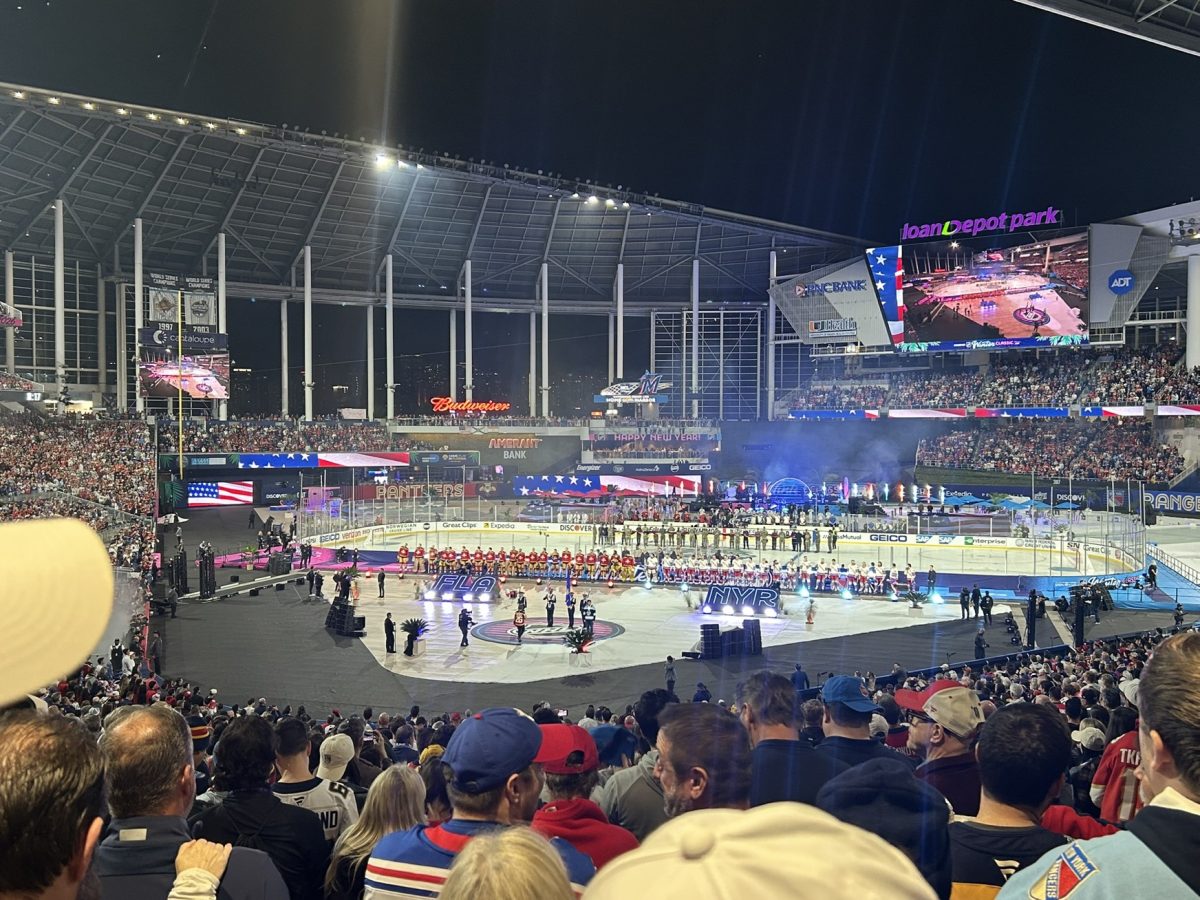
On January 2, the National Hockey League tried something it had never done before: outdoor ice hockey in Miami. That experiment took the form of the annual NHL Winter Classic, with the Florida Panthers taking on their heated rivals, the New York Rangers, at LoanDepot Park. A baseball stadium in South Florida is not the most obvious setting for one of the league’s most traditional events, and from the start, the night felt like a test of how far hockey’s boundaries could really stretch.
Since its debut in 2008, the Winter Classic has been one of the NHL’s most annual events. Traditionally played in cold-weather cities, the game is designed to evoke nostalgia with an old-school feel. Past Winter Classics have taken place in cities like Boston, Chicago, and Philadelphia. Beyond the setting, the event is known for strong production values and a focus on the atmosphere, meant for hockey-lovers around the world. That history is what made Miami such a risky, but intriguing choice.
Despite the unusual setting, the NHL’s reasoning was clear: hockey in Florida is no longer experimental. Between 2020 and 2025, the Florida Panthers and Tampa Bay Lightning won four Stanley Cups combined and appeared in the Stanley Cup Final for six consecutive years. The Panthers were also crowned back-to-back Stanley Cup champions this past season. Hosting the Winter Classic in Miami was meant to symbolize that hockey’s identity has expanded beyond traditional markets.
Ransom Everglades student Sofia Mena ’27 attended the game and initially thought that “it was going to be hard to pull off because of the weather and lack of hockey infrastructure in Miami. Unlike many places where it has been hosted in the past, there are no outdoor ice rinks anywhere here.”
Longtime hockey fans also questioned whether Miami could replicate the atmosphere that defines the Winter Classic. Ms. Michele Rydborn, a math teacher at Ransom Everglades and an avid hockey fan, attended the 2014 Winter Classic at Michigan Stadium. “It was crazy cold, and there was so much snow,” she said. “However, the atmosphere was electrifying. There were so many people, and it was cool to be part of the biggest outdoor Winter Classic game in history.”
The biggest concern entering the game was the ice itself. Miami’s heat and humidity make natural outdoor ice impossible, which is why LoanDepot Park’s retractable roof became a necessity. Advanced cooling systems beneath the ice’s surface were not enough to guarantee the ice stay intact, which is why the NHL relied on the ability to close or partially open the roof depending on conditions.
But the roof complicated the event’s identity. The flexibility allowed the game to technically be played outdoors, but fans said it never fully expressed the open-air feeling they expect from the Winter Classic. Instead of a wide, exposed environment typical of a normal outdoor venue, the game felt partially enclosed, which was enough to remind everyone why this had never been attempted before.
That disconnect may explain why the Miami edition felt different even to seasoned fans. Ms. Rydborn admitted she was surprised by the location. “Although ice hockey is growing in South Florida, it just doesn’t give the same vibe as previous outdoor games,” she said.
The crowd reflected another reality of hockey in South Florida: the sport is still building its cultural footing. Rangers fans appeared to outnumber Panthers fans throughout the stadium, even though the Panthers were technically the home team. New York’s large traveling fan base, combined with South Florida’s transient population and the rivalry between the two teams, contributed to an atmosphere that, to some spectators, felt more neutral than homegrown. While the Panthers have earned massive success on the ice, their fan base is still in the process of becoming generational rather than inherited.
Mena said that the crowd felt divided. “I was sitting next to a lot of Rangers fans, and they were very loud,” she said, adding that while “the Panthers lost, which sucked,” the overall atmosphere was still enjoyable.
The choice of venue also introduced challenges that were not unique to Miami. Winter Classics have often been staged in baseball parks, like Fenway Park and Wrigley Field, and while those venues provide iconic visuals, they are not designed for hockey. At LoanDepot Park, as with other ballparks, the rink sat far from much of the seating bowl, making it difficult to consistently track the puck regardless of seating location.
Despite sitting close to the ice in row sixteen, Mena said “it was hard to see the puck since the rink was in the middle of the field. I could not see the puck at all if it got close to one of the goals, and I had to watch the TV at some points to see the game.”
Even with these shortcomings, the mere fact that the game was playable in Miami was an accomplishment itself. Outdoor hockey under palm trees, even with compromises, was a striking visual and a reminder of how far the sport has expanded. For many fans, simply seeing ice hockey staged in a city better known for beaches than rinks made the not-so-cold night feel special, regardless of its imperfections.
Mena “enjoyed it.” She added that she would even attend another outdoor game, “especially if it is in a place other than Florida because an outdoor hockey game could be so much better with a better ‘winter’ environment.” Even though she had a much different experience, Rydborn echoed that sentiment, saying, “I think I would go again. It was fun and made for good memories with my husband.”
Hockey has clearly found a home in the Sunshine State, and the league continues to build on that presence. In February, the Lightning will host their own Stadium Series game against the Boston Bruins, offering another opportunity to showcase outdoor hockey in Florida; this time with the benefit of lessons learned from Miami’s bold and ambitious experiment.