
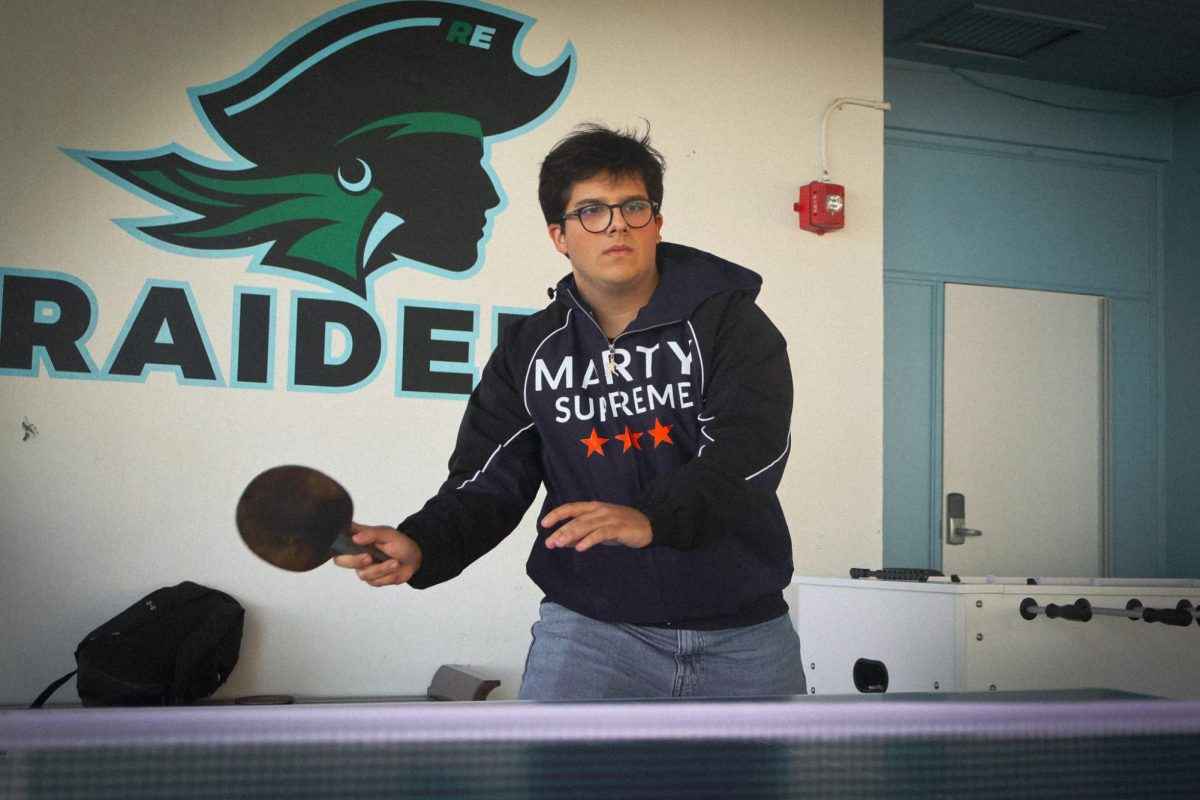
Marty is Insufferable. That’s Why We Love Him.
By Lucia Corrochano ’26
Josh Safdie’s “Marty Supreme” hit theatres on Christmas day and immediately caught the eyes of millions through cool-looking jackets and an incredible all-star cast, featuring Timothee Chalamet, Odessa A’Zion, Gwyneth Paltrow, Tyler the Creator, and more. Safdie’s first solo directing project has grossed nearly $60 million worldwide and is ”shaping to be one of A24’s most successful movies,” according to IMDB. The movie tells the story of Marty Mauser, an aspiring table tennis player in 1952 loosely based on Marty Reisman who goes to hell and back to prove his talents and, frankly, feed his ego and his pockets.
In short: I liked it, but I would never watch it again.
Ironically, the film features more bullets than ping pong balls. Marty Supreme is ridiculously intense. People get stabbed, shot, die, and nearly set on fire, all in an attempt to reach an utterly laughable goal: a spot in the table tennis world championship in Tokyo following Marty’s defeat against Koto Endo, a Japanese player who quickly becomes his nemesis. Every single character in the film feels the effects of Marty’s egotistical decisions, a flicker to a few but a wildfire to the unlucky.
Any viewer with an ounce of empathy in their heart will quickly grow to hate this character, as I did. Yet I still somehow stayed engaged from start to finish.
Marty Mauser is a masterclass in creating the perfect unlikeable character. We stay by his insufferable side for two and a half hours as he continues to get into impossible situations for cash or pride.
But why? Why do we watch him mess up over and over to reach a stupid finish line, while constantly failing the only likeable characters in the film?
The answer is simple: you just want to see how far he can actually go. His charisma and impalpable conviction keep your eyes on him, just to make you wonder to yourself how he’s going to get himself out of this one every twenty minutes. He begs his audience to take him seriously and trades any semblance of emotional vulnerability for respect in his field. The movie uses Chalamet’s talents to pull off every stunt possible to inconvenience Marty and everyone who surrounds him. Marty is an earthquake in every room he walks into, and he somehow manages to walk into the next one like he owns it every single time. He convinces everyone, including his audience, that he, somehow, will pull it off.
The snappy dialogue and the terribly selfish decisions, along with incredible character craftsmanship, make this exactly what it’s meant to be: a hard watch. The two and a half hours do not fly by on purpose; we suffer along with Marty and eventually become another victim of his self-centered mindset just to see him jump around on screen playing ping pong like it’s the Olympics—or the senior deck after lunch.
Every eyeroll and gasp from the audience proves to be worth it in the end, and not because of the ending itself at all. The character of Marty Mauser feels complete when we finally see through the shallowness of his facade. This movie is a study in passion, yet without the word’s normally positive connotations. The movie shows us the ugly side of determination and the trenches of the male ego. Passion can be ugly and lead to bad decisions; Marty embodies this perfectly. You’ll hate him. But you won’t be able to look away.
Jewish Identity in Marty Supreme
By Samuel Bussel-Alonso ’27
Set in the Jewish immigrant world of post–World War II New York and loosely inspired by real-life table-tennis hustler Marty Reisman, the film ties Marty Mauser’s flamboyant ambition to a specifically Jewish-American struggle for visibility and legitimacy. Rather than offering a redemptive narrative of ethnic pride or successful assimilation, the film leaves Marty’s Jewish identity unresolved, exposing the psychological and moral costs of trying to escape marginality.
Marty grows up on the Lower East Side, surrounded by Yiddish signage, immigrant poverty, and dense Jewish communal life. This environment situates him within a recognizable mid-century Jewish world shaped by economic precarity and generational aspiration.
Yet Marty’s Jewishness is also haunted by a trauma he did not directly experience. Living in the shadow of the Holocaust, Marty occupies an uneasy position as a second-generation American Jew.
Through Marty’s character and persona, the film seems to dramatize how younger Jews struggle to claim or metabolize trauma. Marty’s need to “prove” himself—through exaggeration, conquest, and amazement—invites the audience to think about his actions as a response to an inherited burden.
And yet, throughout the movie, Marty embodies the opposite of a mensch. Everything he pursues is rooted in self-aggrandizement rather than caring for others. Instead of treating his Jewish heritage as a source of ethical obligation, he turns it into a show about exerting his dominance, using success as proof of personal worth rather than as a means of service. He repeatedly endangers and manipulates the people around him in order to sustain his myth of exceptionalism, leaving emotional and material damage in his wake.
Although his environment and relationships reflect historical reality, Marty’s obsession with rising above his trauma through dominance and recognition drives him toward deceit and violence. His compulsive need to “prove himself” functions as his tragic flaw; to appease it, he commits crimes, lies, and damages his moral compass. In attempting to uplift his Jewish community, he ultimately betrays it. Rather than becoming the triumphant figure he imagines, the film leaves open the question of whether Marty truly becomes “Hitler’s nightmare,
The film develops an interpretation of Jewishness as simultaneously an inherited obligation and a source of resilience. This is Marty’s story: he is both the anti-mensch and tenacious in all he does.
We Have Seen Marty Supreme Before
By William Stockman ’28
As I sat in the theater watching “Marty Supreme,” I couldn’t shake the feeling that I had already seen this movie. After watching the credits roll, I knew exactly why.
Produced by A24 and directed by Josh Sadfie, “Marty Supreme” and “Uncut Gems” have similarities that go far beyond the production team.
“Uncut Gems” (2019) is a crime thriller starring Adam Sandler as Howard Ratner, a charismatic New York City jeweler. Due to his gambling addiction, he constantly risks his family, career, and life to clear massive debts.
In the same way that “Uncut Gems” isn’t really about jewelry, “Marty Supreme” isn’t really about ping pong. They are merely a backdrop for our protagonists to spiral out of control.
Both Ratner and Mauser are unlikeable characters, yet we still root for them, the perfect anti-hero. Both are Jewish-American hustlers who will lie, cheat, and steal uncaring of the trail of destruction they leave behind them. They use their charm to get what they want and quick wits to escape situations into which they put themselves.
These movies not only build tension through escalating high-stakes schemes, but use chaotic shot composition and overwhelming sounds to rarely leave the audience with breathing room. And when they do break up the relentless tension, they present bizarre, unsettling scenes, from the inside of Adam Sandler’s colon to the infamous “padel scene” in “Marty,” which you just have to see for yourself.
Both movies are filmed in New York, and the city plays a vital role in shaping their stories. The Upper East Side in “Uncut Gems” is underscored by addiction and organized crime. It’s just as chaotic as the tenement houses of Lower Manhattan in “Marty Supreme,” which challenge the city’s reputation as a place of opportunity, revealing the harsh realities of the immigrant experience in the 50’s.
While I argue that both movies are about gambling, there is a key difference. Howard is an addict who gambles on sports. Marty is ambitious; he gambles on himself.
Marty’s ambitions are pure in his pursuit of an unattainable dream, which makes him a redeeming character. Howard doesn’t have any of these qualities, and he pays the price.
From the outside Howard seems to have it all, a wife, kids, and is clearly very wealthy. By the end of his story, he is left with nothing, making it a story about self-destruction. By contrast, Marty seems to start out with nothing. He works a job he hates to barely scrape up enough money to play ping pong. In the end, he does not reach his goal, yet he feels fulfilled, finding purpose greater than his superficial dream of becoming champion. This is why the ending of “Marty Supreme” is satisfying: whereas “Uncut Gems” ends with death, “Marty Supreme” ends with rebirth.